ICU-1111 · Coaching Framework Library

You don't have a
motivation problem.
You have a
pattern problem.

Your patterns aren't random. They're the predictable output of wounds that were never finished healing. Once you can see the pattern, you are no longer inside it. That's the entry point. That's the work.

"You are not living in the past. Your past is living in you."
The Foundation · Worth
Three Ways of Relating to Your Own Worth

Worth that requires proof
is worth that can be disproven.

Most people are running on one of two types of worth — and neither one actually works. Performance-based worth says "I must generate proof." Borrowed worth says "I must collect proof from others." Both are exhausting. Both are one bad day away from collapse. Because proof-dependent worth depends on conditions that are always outside your control.

Performance-Based Worth

Prove It

The workaholic. The overachiever. The person who cannot sit still because sitting still means the proof might stop. Every achievement is added to the case for why they deserve to exist — and still, it's never enough. Love becomes a transaction: I perform, you confirm.

Borrowed Worth

Collect It

The people-pleaser. The chronic over-giver. The person whose sense of self reorganizes around whoever is in the room. Approval, belonging, acceptance — the currency. It leaves every time the person does. You can never collect enough of it.

Structural Worth

Just Be It

Not confidence. Not self-esteem as a performance. The quiet, load-bearing knowledge that your worth was never actually attached to being right — or to being approved of. Present. Not performing for the future. Not managing the past. Just here. This is the destination.

"Just being. Just living. Just present. Not because you proved it. Not because someone confirmed it. Because you let reality in — and you are still here."
The Identity Spectrum
Self-Authorship ↔ Empathy

There are two things you can do
with your inner life.

You can author yourself — know what you want, feel your own feelings, act from your own truth. Or you can dissolve into others — feel what they feel, want what makes them happy, exist in relation to their needs rather than your own. Most people are drifting toward one extreme or the other. Neither is the destination.

Destination: a fully formed identity · integrated
◀ Narcissistic driftalone → entitlement
Integratedmembrane not wall
Borderline drift ▶alone → self-erasure
Logic Pole · Left

Self-Authorship

Know what you want — author yourself.

The capacity to generate your own identity from the inside. To know what you feel, what you want, what you value — not because someone told you, not because it keeps the peace, but because you know yourself.

What happens when it's unchecked

At the extreme it becomes a sealed narrative. They are always right — even when evidence proves otherwise. Being wrong, in their mind, is being worthless. So the walls go up. Not because they are strong — because they cannot afford to find out they are not.

They permit only power emotions: confidence, anger, pride. Soft emotions — sadness, fear, vulnerability — are not allowed. So they judge others for having them. When you cry, they read it as weakness. That's not their strength. That's their wound.

They take credit. Enthusiastically. But accountability — the mirror image of credit — is nowhere. They can't be the author of their victories and a bystander to their damage. That's not authorship. That's performance.

"What if you weren't right — and you were still okay?"
The Integrating Function · Center

Boundaries

A membrane, not a wall — discerning and open.

The word "boundary" has been reduced to a line you draw. But a real boundary is alive, responsive, and selective — like a cell membrane. It knows what to let in and what to keep out. Not a wall. Not wide open. It discerns.

What integration actually looks like

Can receive information without losing self. Can disagree without requiring the other to be wrong. Says no from values, not from fear. Feels another's pain without absorbing it. Accountability without self-destruction. Repair is possible — disagreement isn't rupture.

Shame metabolized is accountability. Shame ejected is blame. Shame absorbed is identity. The integrated person can hold shame, evaluate it, own it or set it down — without it destroying them.

"The plain true thing: you are a person, among people. Taking up the right amount of space."
Emotion Pole · Right

Empathy

Feel deeply without disappearing.

The capacity to move toward another's experience without losing the thread back to your own. Resonance without absorption. Presence without dissolution.

What happens when it's unchecked

"Whatever you want" — not as generosity, but as genuine absence of a preference to offer. Resentment builds for things that were never voiced, in situations they allowed. When someone finally asks their opinion, they don't know. They need someone to tell them what to want.

They apologize for existing before anyone signals inconvenience. They can't receive a compliment without explaining it away. They take accountability for everything — and credit for nothing. Invisible to themselves first. Then invisible to everyone else.

They were often taught their feelings were wrong or too much. So they buried the access point. The body has been keeping the accounting ever since.

"What if you weren't as wrong or as bad as you think — and you didn't have to prove or justify your existence?"

Both extremes are running the same fear.

I am worthless.

Same wound. Opposite defenses. One builds walls so the fear can never be confirmed. The other disappears so the fear can never be risked. Both are grandiose — just in opposite directions. One is the sun. One is the black hole.

"You are not the greatest. You are not the worst. You are a person — among people. Neither the most important nor the least. Neither always right nor always wrong. Just a person who takes up the right amount of space and knows it."
Do You Recognize Yourself?
Signs you're drifting toward self-erasure
  • 01
    You know what everyone else needs before you know what you needReading the room before reading yourself. The thread back to your own experience has gone quiet.
  • 02
    Saying no feels like a relationship-ending eventWhen a limit feels like a betrayal, the boundary isn't a membrane — it's a collapse point.
  • 03
    You're exhausted by people you loveNot because they're too much. Because you're pouring from a tank that was never filled — and the body is billing you for it.
  • 04
    You apologize before anyone indicates inconveniencePre-emptive shrinking. The apology arrives before the offense. Taking up space still feels like something that requires justification.
  • 05
    Your body has been louder than usualPain, fatigue, inflammation, anxiety. The body doesn't malfunction — it reports. The accounting department has been sending memos.
Signs you're drifting toward self-authorship extreme
  • 01
    When confronted with evidence of wrongdoing, the story shifts — not the behaviorThe narrative gets rewritten. The other person becomes the problem. Accountability requires rewriting, and the ego can't hold that.
  • 02
    Apology, when it comes, is about image restoration — not repairThe apology is structured to make them look better, not to make the other person feel better. Those are different things.
  • 03
    You can't sit still when someone expresses an emotion you don't permit yourselfCrying, fear, vulnerability — it makes you want to fix, dismiss, or leave. That discomfort is your emotional restriction becoming someone else's problem.
  • 04
    Achievement has become identity rather than expression of itWithout the output, you're not sure who you are. That's performance-based worth — and it's a very expensive way to live.
  • 05
    The people closest to you walk on eggshellsThey've learned to manage your reactions. That's not closeness — that's a shared wound management system.
Framework One · The PAST Framework™
The Diagnostic — Understanding Your Patterns

The PAST Framework™

"You are not living in the past. Your past is living in you."

The PAST Framework identifies the four patterns that emerge from incomplete identity. These aren't character flaws — they're survival strategies that outlived their usefulness. Once you can see the pattern, you are no longer entirely inside it.

P
The Pairing

Wounds Recognize Wounds

You don't choose who you're drawn to randomly. Our unhealed wounds act as signals — attracting people and situations that mirror what we haven't yet resolved. The self-authorship extreme needs someone to hold their blame. The empathy extreme needs someone certain enough to borrow worth from. They find each other. Not chemistry — complementary wound management. Neither is choosing consciously. Both are choosing by wound.

A
The Audition

Performing for Love

When love was conditional in childhood, we learned to audition. Not to show up — to perform. To give from fear rather than fullness. Every act of generosity is also a bid for continued acceptance. Love becomes a transaction. Presence is never available because you're always rehearsing. There is no performance that secures worth permanently. The tank empties. The body files the report.

S
The Squeeze

Pressure Reveals Truth

Under pressure, we don't rise to our intentions — we fall to our patterns. The Squeeze is the moment when the defense system fails and reality breaks through anyway. Crisis, conflict, illness, loss, relationship rupture. It was always going to happen. The body was always going to file the report. The Squeeze is not a failure. It is an initiation. The distortion finally cracked enough to let something true in.

T
The Tank

What You Carry Is What You Pour

You cannot pour from an empty tank — and you cannot give structural worth to someone else until you have it yourself. Most high-achievers are running on performance-based worth and borrowed worth. The tank has never been full. What pours from a tank that runs on performance is more performance. What pours from a tank that runs on borrowed worth is more need. The work of filling the tank is identity completion.

Framework Two · The Solution

The DEAL Framework™

"Problems aren't the problem. How you DEAL with them is."

The DEAL Framework is the path from the pattern to the person underneath it. It doesn't prescribe the same thing for everyone — what each step requires looks completely different depending on which direction you're coming from. That's what makes it work.

D
Don't Resist Reality

The First Honest Look

Everything in the PAST Framework is, at its root, resistance to reality. D is the moment you stop. The first honest look at what is actually true — from your side of it.

For the self-authorship extreme: Let it land. You were wrong. You are still here.
For the empathy extreme: See yourself. You have been absent from your own life. Being seen will not kill you.
E
Embrace Discomfort

The Swing Itself

The pendulum has to swing the other way before it finds center. This is the overcorrection — the unfamiliar territory. This is where most people quit. They think the discomfort means they're doing it wrong.

The discomfort of the swing is the doing. The pendulum doesn't stop at the apex. It returns. But it can't find center from a place it has never left.
A
Adjust Perspective

Where the Swing Slows

Where you look back and see how far the pendulum went and begin to calibrate. The plain true thing becomes available: you were wrong and you are okay. You exist and you are allowed.

Not positive thinking. Accuracy. The distortion was inaccurate in both directions. A is the return to what is simply true — neither the greatest nor the worst, just a person.
L
Level Up

The Return to Center

Structural worth. Just being. Present. Not performing for the future. Not managing the past. The integrated person can be wrong without collapsing. Can be rejected without erasing.

Not an achievement — a return. Not to the original position. Not to the opposite extreme. To the middle. Where you can hold complexity without being overwhelmed by it.
The Capacity Framework
Original Definition · Anju Redheendran · June 4, 2026
"Maturity is the development
and/or expansion of a capacity."
© Anju Redheendran · ICU-1111

Maturity isn't acting a certain way. It isn't reaching a certain age. It is the expansion of what the system is capable of — emotionally, physically, spiritually, relationally. And here's what changes everything: most adults are not operating at their chronological capacity. They're operating at the capacity of the age when the wound happened.

How Capacity Develops

Nature + Nurture

You cannot expand into something you've never seen modeled. The nervous system learns by witnessing, then practicing, then integrating. If conflict in your home always ended in blame with no resolution — you didn't learn that conflict is resolvable. You learned it's dangerous. That's not a character flaw. That's the ceiling of what was available.

Why You're Not Broken

Arrested Capacity

The behavior is always the ceiling of the current capacity. The forty-year-old who can't be wrong without collapsing may be working with the shame-processing capacity of an eight-year-old. The person who disappears in relationships may be working with the attachment capacity of a four-year-old. The chronological age is not the emotional age.

What the Work Actually Is

Expansion

Witnessing → Practicing → Mastering → Exploring. Once it's modeled and practiced safely, it becomes a skill you've mastered. Then it becomes something you feel comfortable exploring. That's becoming a better person — not more controlled, not more disciplined. More capable. Of more things. With more people.

Coaching Intake · The Willingness/Exposure Grid
Where Are You Right Now?

The Willingness /
Exposure Grid

Before any coaching work begins, two questions: Are you willing to change this? Have you ever seen it done differently? The answers determine where we start — not whether growth is possible.

Exposure: Yes
Has seen it modeled
Exposure: No
Has never seen it done
Willingness: Yes

Growth

You want to change AND you've seen it modeled. All conditions are present. This is where we begin the actual work.

→ Begin directly

Longing

You genuinely want this — but you've never seen it done. Motivation isn't the problem. You need a model before anything else.

→ Start with modeling
Willingness: No

Stagnation

You know it's possible — you've seen it. But the cost of changing still feels higher than the cost of staying. Something is protecting the pattern.

→ Explore the block

Absence

Neither condition is present yet. This isn't failure — it's the most defended position because the wound underneath is deepest. We start with safety.
→ Build safety first
"The Squeeze is often the catalyst that creates willingness where none existed. The willingness that emerges from crisis is real — often more real than willingness chosen in comfort. The work that begins there is the most durable."
The Cylinder Principle · Mercy · Truth
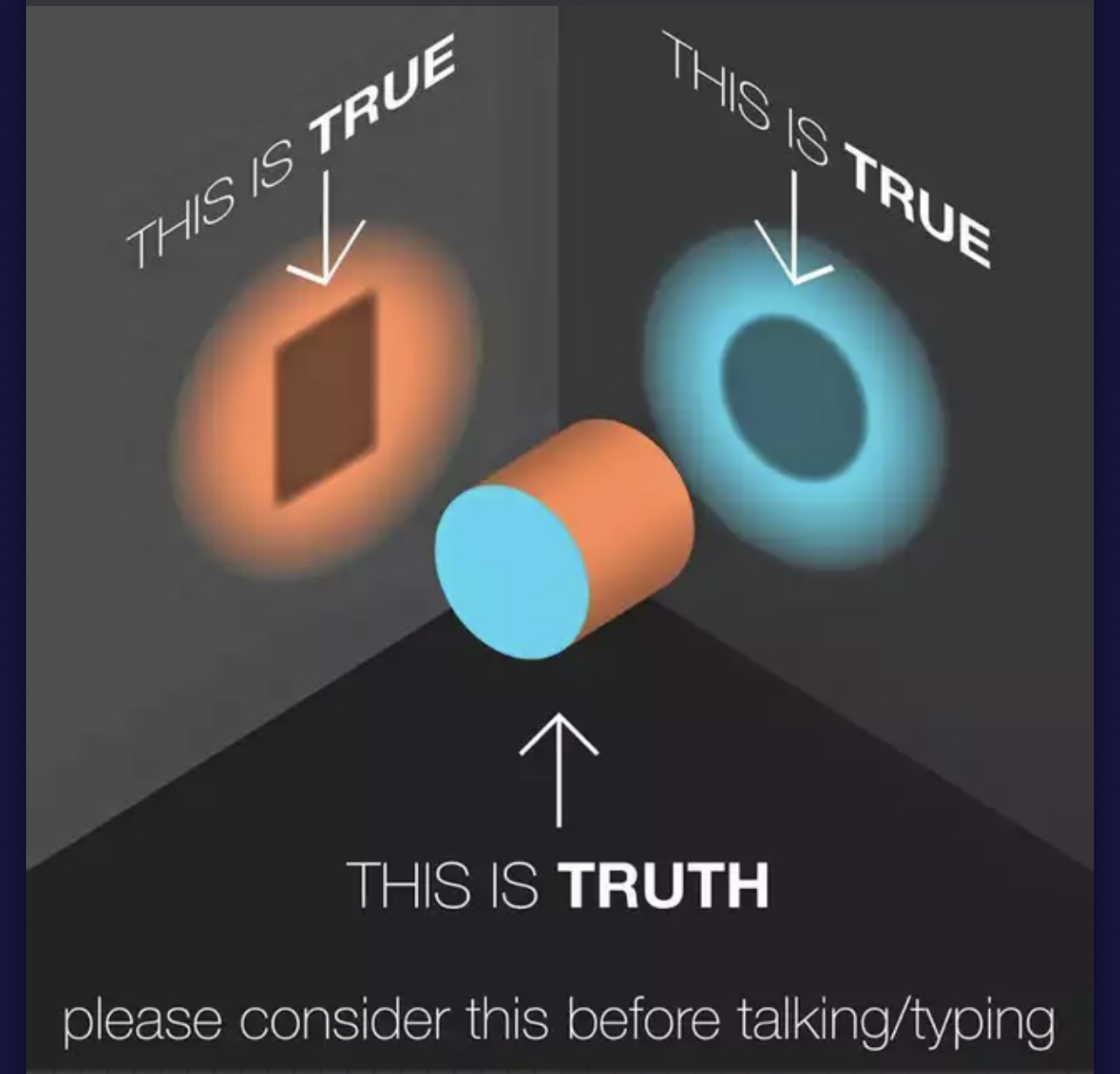
The Cylinder of Truth: two shadows — a rectangle and a circle — both labeled THIS IS TRUE. The cylinder casting them labeled THIS IS TRUTH.
The Geometry of Perspective

Two truths.
One Truth.

Both shadows on the wall are real. Both are accurate — from where each person is standing. Neither person is lying. Neither shadow is the whole truth. The cylinder was always there.

"You can be completely right about what you saw — and completely wrong about what it means."

Mercy is holding that the other person's shadow on the wall is real to them — not manipulation, not a lie, just an incomplete angle. Grace is accepting that neither shadow is the whole cylinder — including your own.

Seeing the cylinder doesn't obligate anyone to change. The choice belongs entirely to you. That's where accountability enters — and it's the piece that makes this applicable to adults rather than just philosophical.

The Accountability Asymmetry
SELF-AUTHORSHIP EXTREME

Takes credit enthusiastically. Accountability is nowhere. You can't be the author of your victories and a bystander to your damage.

EMPATHY EXTREME

Absorbs blame readily. Credit — the mirror image of accountability — lands nowhere. Can't receive what they earned.

"Real authorship holds both: I did something good — that was mine. I caused harm — that was also mine. Not one or the other. Both."

Ready to stop performing
and start inhabiting yourself?

A 30-minute discovery call to identify where you are on the spectrum, which patterns are running, and where your capacity is ready to expand.

Coaching Framework Clinical Version Anju's Site ICU-1111